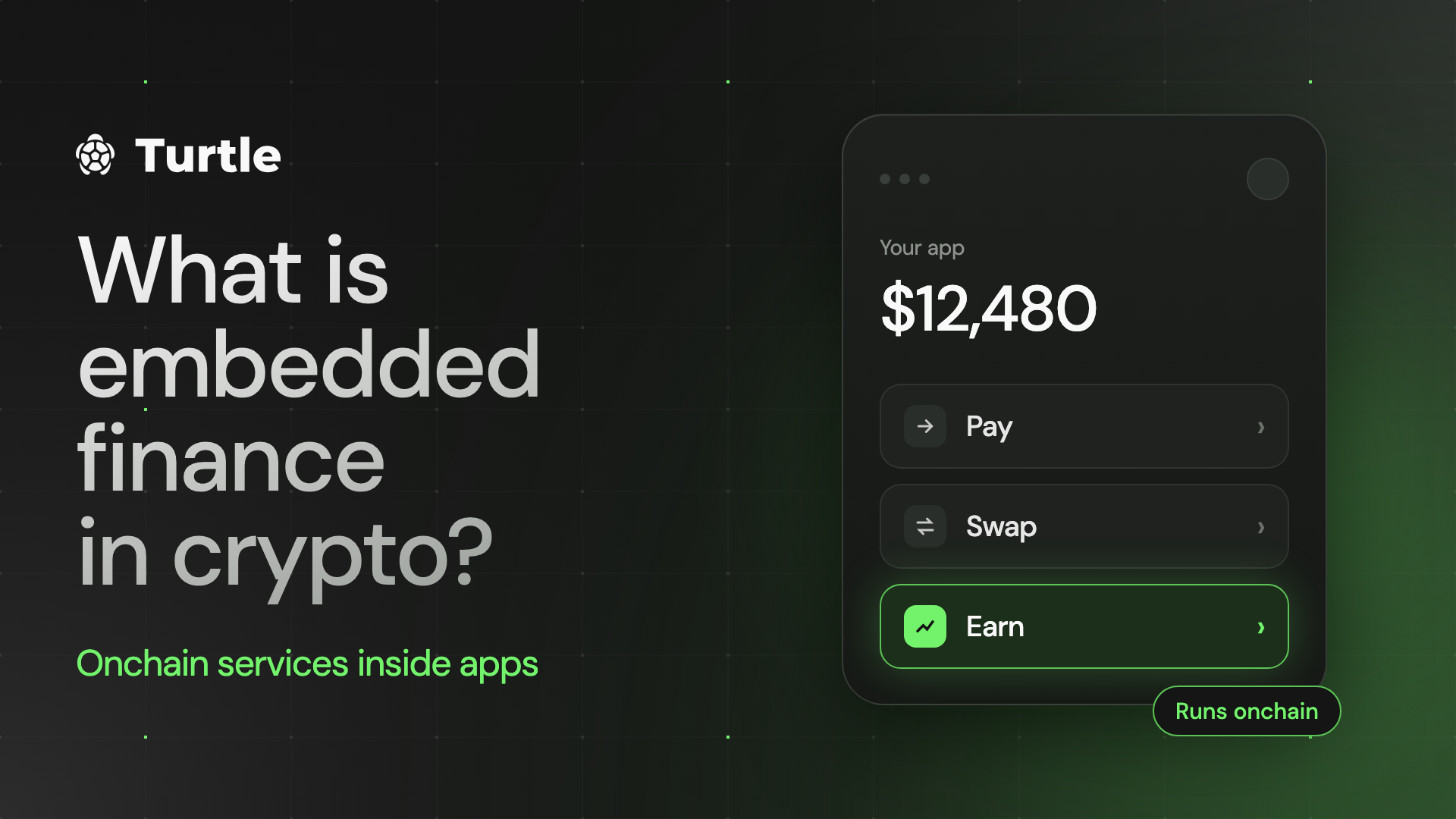

Embedded finance is the practice of building financial services, such as payments, loans, cards or savings, directly into an app or platform whose main business is something else. In crypto, the same idea means a wallet, exchange or neobank offers onchain services like stablecoin payments, swaps or yield inside its own interface, while smart contracts and specialist providers run the service underneath. The user stays in the app they already trust, and the app earns from a feature it did not have to build from scratch.
Stripe defines embedded finance as financial services "built directly into nonfinancial platforms so users can access them without leaving the platform" (Stripe). This guide covers the general meaning first, then how the model works onchain, where yield fits and what to check before a platform adds it.
What does embedded finance mean?
Embedded finance means a financial product shows up at the moment a person needs it, inside a product they are already using. Fiserv describes it as the delivery of any kind of financial service "at the point of need" (Fiserv).
You have probably used it many times. Paying for a ride inside a ride-hailing app, splitting a purchase into four payments at an online checkout and adding travel insurance while booking a flight are all embedded finance. The company you deal with is a ride app, a store or an airline. A bank, lender or insurer provides the actual product in the background.
The most common types are:
| Type | What the user sees | Example |
|---|---|---|
| Embedded payments | Pay without leaving the app | One-tap checkout in a delivery app |
| Embedded lending | Credit offered at the point of sale | Buy now, pay later at checkout |
| Embedded insurance | Cover offered with a purchase | Travel insurance when booking a flight |
| Embedded banking | Accounts and cards under the app's brand | A payout account for gig workers |
| Embedded investing and savings | Grow a balance inside the app | Round-ups or an interest-earning balance |
How does embedded finance work?
Every embedded finance product has three roles, even when the user only sees one brand.
- The platform owns the customer and the interface. It decides where the financial feature appears and how it looks.
- The infrastructure provider connects the platform to the financial product through an API or SDK. In traditional finance, this is often called banking as a service (BaaS).
- The licensed or regulated provider holds the money, takes the credit risk or issues the policy. It carries the compliance work.

The platform gets a new feature and a new revenue line. The provider gets distribution to users it would never reach on its own. The user gets the service where they already are.
What is embedded finance in crypto?
Embedded finance in crypto follows the same three-role pattern, with one big change in the bottom layer. Part of the work a bank does in traditional finance is done by public smart contracts: lending markets, decentralized exchanges and yield vaults that anyone can integrate.
That changes what a platform can offer. A wallet can show a swap from inside its own screen, an exchange can add an earn tab, and a fintech app can let users hold stablecoins and put them to work. The common onchain features are:
- Stablecoin payments and transfers that settle at any hour.
- Swaps between tokens without sending the user to a separate exchange.
- Staking of network tokens to help secure a blockchain.
- Yield on deposits through lending markets and vaults.
The crypto industry has a nickname for this setup: the "DeFi mullet", a familiar fintech front end with DeFi running at the back. A later Turtle guide covers the term in detail.
Custody is the biggest design choice. In a self-custodial wallet, the user signs every transaction and the assets go straight into the smart contract they chose. In a custodial app, the platform holds the assets and makes the deposit for the user. Both models exist, and they carry different risks and rules.
What does the onchain embedded finance stack look like?
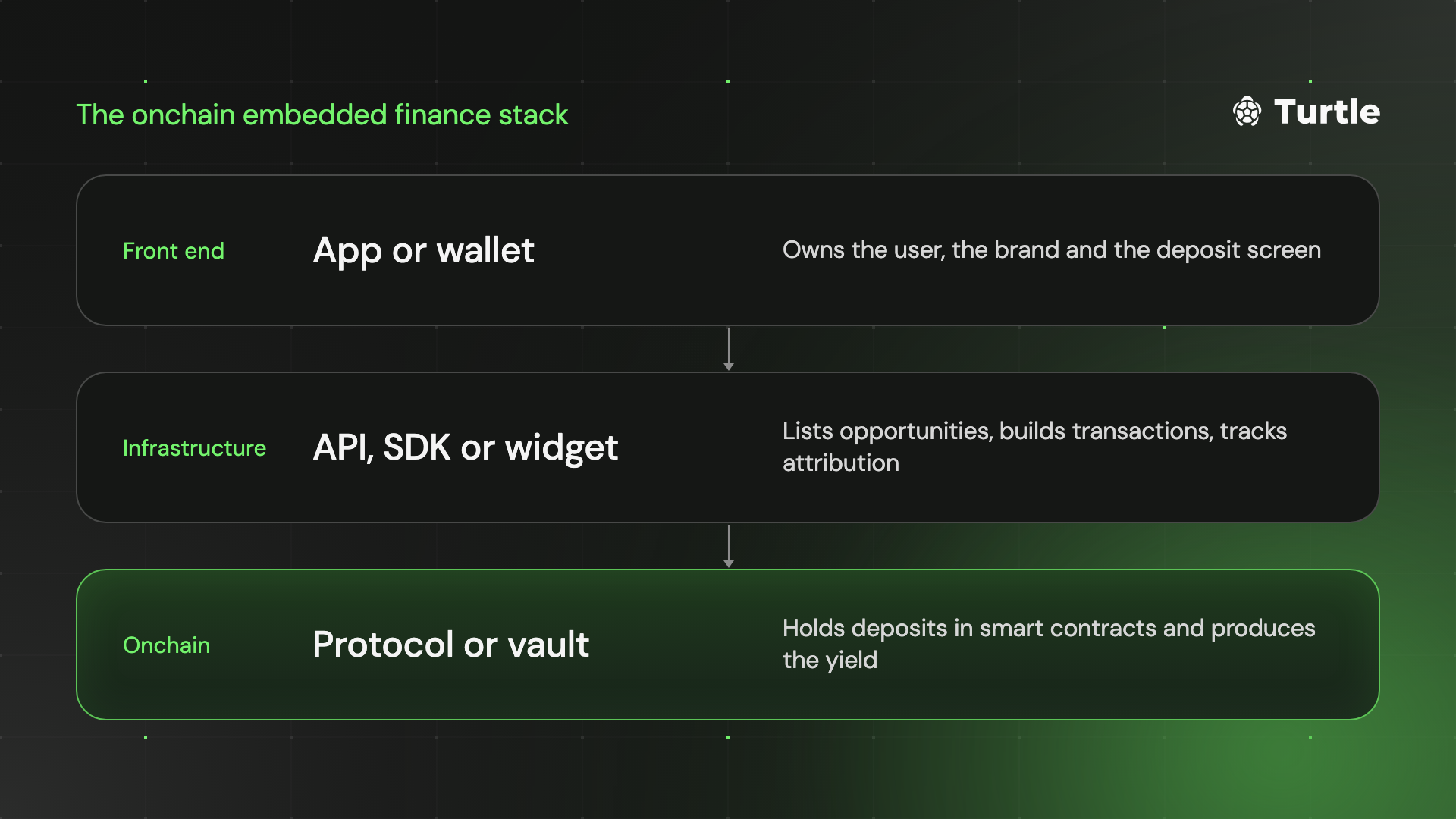
The onchain version of the stack has three layers, each with a clear job.
The app owns the user, the infrastructure builds the transactions, and the vault produces the yield.
| Layer | Who it is | What it does |
|---|---|---|
| Front end | Wallet, exchange, neobank, app | Owns the user, the brand and the deposit screen |
| Infrastructure | API, SDK or widget provider | Lists opportunities, builds deposit and withdrawal transactions, tracks activity |
| Onchain protocol | Lending market, vault, DEX | Holds the deposits in smart contracts and generates the return |
Standards make the bottom layer easier to plug into. ERC-4626, for example, gives tokenized yield-bearing vaults one common interface, which Ethereum's documentation says lowers "the integration effort" for applications that want to offer yield (ethereum.org). If you want to know what happens inside that bottom layer, read how crypto vaults work.
Where does yield fit in embedded finance?
Yield is the crypto version of an interest-earning balance, and it is one of the most requested embedded features. Users who hold stablecoins or ETH in an app often want those assets to earn something, and the app wants them to stay.
Building that feature in-house is a lot of work. A platform would need to pick and review vaults, write the deposit and withdrawal logic for each one, follow positions across chains and measure what it earns from the feature. This is why many platforms embed yield from a provider, a model often called embedded yield or yield as a service. A future Turtle guide explains embedded yield on its own.
Three questions shape any embedded yield product:
- Where does the yield come from? Borrowers paying interest, trading fees, staking rewards or incentives funded by a protocol. Each source has its own risk.
- Who reviewed the opportunity? A vault's smart contracts, curator and strategy all need checking before users see it.
- How does the platform get paid? Fees, revenue share or a spread, and how deposits are credited to the platform.
Returns change with market conditions. Any rate an app shows is variable, and no yield product can promise a fixed outcome.
Why do apps and wallets add embedded finance?
Platforms add embedded finance for three reasons.
Users want it where they are. A person who already holds stablecoins in a wallet is more likely to use a yield feature inside that wallet than to move funds to a new app.
It adds a revenue line. A platform that sends deposits to an onchain opportunity can earn a share of what those deposits generate. Payments and swaps can carry fees in the same way.
It keeps balances on the platform. A balance that earns something has a reason to stay. That supports retention for wallets and exchanges, where users can move funds at any time.
What are the risks of embedded finance in crypto?
Embedding a financial product also means taking responsibility for what users see. The main risks to check are:
- Smart contract risk. A bug or exploit in a vault or protocol can cause losses, and audits reduce this risk without removing it.
- Strategy and curator risk. A vault's return depends on how its manager allocates funds and handles market stress.
- Custody risk. In a custodial model, users depend on the platform holding their assets. In a self-custodial model, they depend on their own key management.
- Liquidity risk. Some vaults settle withdrawals over time, so users may not get funds back instantly.
- Regulatory risk. Rules for crypto yield and stablecoins differ by country and keep changing, so platforms need their own legal review.
- Attribution risk. If deposits are not credited to the platform correctly, the revenue model breaks.
A clear review process for every opportunity and plain disclosures in the app help users understand what they are using.
How does Turtle help platforms embed yield?
Turtle is a distribution protocol that connects DeFi yield opportunities with the wallets, exchanges, neobanks and other platforms that distribute them (Turtle docs). Its Distribution product lets a platform put reviewed opportunities in front of its users and earn on the deposits they bring in (Turtle docs).
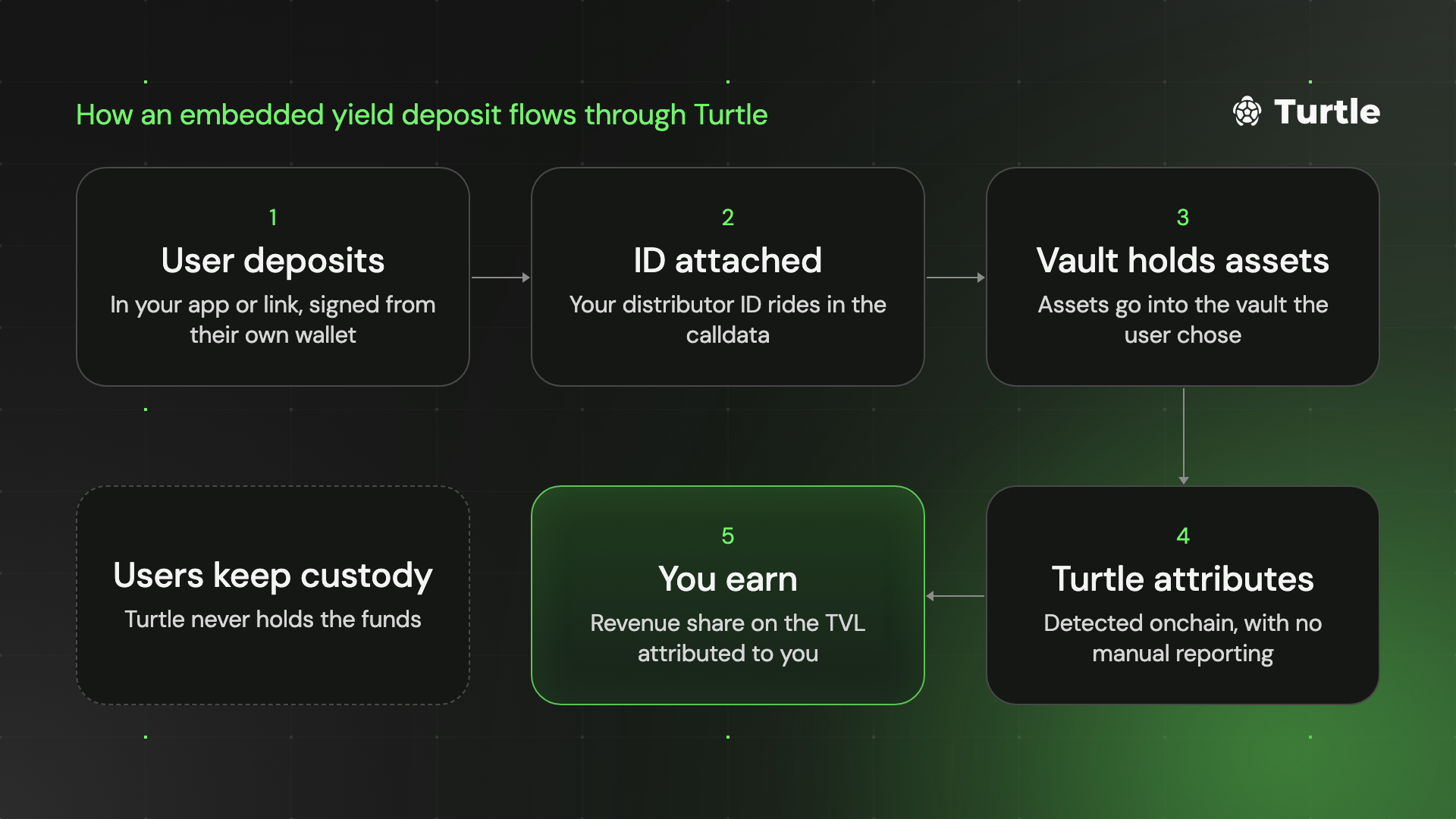
Each deposit carries the platform's distributor ID onchain, so attribution and revenue share happen automatically.
Here is how it works, based on Turtle's documentation:
- Two ways to integrate. Share links need no code and work with Turtle featured deals. The Earn API lets a wallet or app build the deposit flow inside its own interface and covers the full catalog.
- Attribution onchain. Every deposit carries the platform's distributor ID in its calldata, and Turtle attributes it automatically, with no manual reporting (Turtle docs).
- Revenue share. The platform earns recurring revenue share on the TVL attributed to it, for as long as that TVL stays. Rates are set per distributor and are not published as one public rate (Turtle docs).
- Reviewed opportunities. Opportunities are not self-listed. The Turtle Due Diligence Council reviews each vault across technical risk, smart contract exposure, operational risk and curator assessment.
- Users keep custody. Turtle generates an unsigned transaction, the user signs it from their own wallet and the assets go into the vault contract they chose (Turtle docs).
Distribution opportunities span chains including Ethereum, Base, Arbitrum, Avalanche, BSC, Optimism, Polygon, Linea and Scroll. The Turtle API overview lists the full developer surface. If you run a wallet, app or community and want to add yield, start with Become a Distributor.
FAQ
What is embedded finance in simple terms?
Embedded finance is a financial service, such as payments, credit, insurance or savings, offered inside an app or website whose main business is something else. The app owns the experience, and a financial provider runs the product in the background.
What is an example of embedded finance?
Paying inside a ride-hailing app, using buy now, pay later at an online checkout and adding insurance while booking a flight are all examples. In crypto, a wallet that lets users swap tokens or earn yield without leaving the wallet is an example.
What is the difference between embedded finance and banking as a service?
Banking as a service is one way to build embedded finance. BaaS describes the licensed bank and the APIs that provide accounts, cards or payments. Embedded finance describes the result the user sees: the financial feature inside a nonfinancial app.
How does embedded finance work in crypto?
A wallet, exchange or app offers an onchain service in its own interface, an infrastructure provider builds the transactions through an API or SDK, and smart contracts such as lending markets or vaults run the service. The user may sign each transaction from their own wallet or let a custodial platform act for them.
What is embedded yield?
Embedded yield is a yield feature that a wallet, exchange or neobank offers inside its own app, powered by onchain vaults or lending markets through a provider. Users earn a variable return on deposits, and the platform usually earns a share of what those deposits generate.
Is embedded crypto yield risk-free?
No. Embedded yield carries the risks of the underlying protocol, including smart contract, strategy, liquidity and regulatory risk. Returns are variable. Check how each opportunity was reviewed and who holds custody of the funds before you deposit.